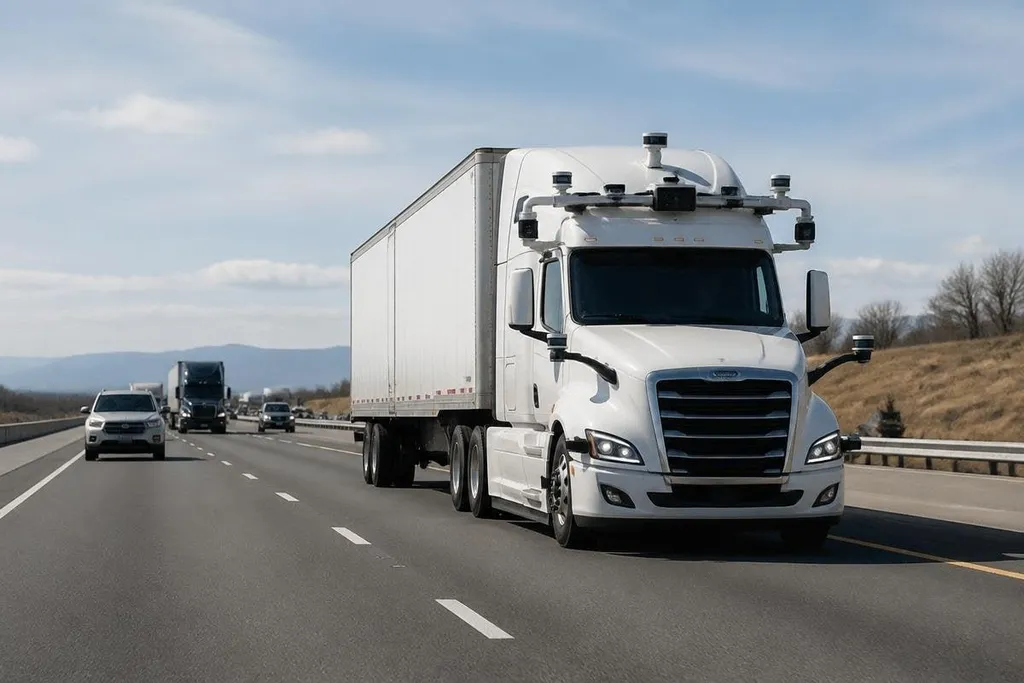
An autonomous truck must read a road, predict what nearby vehicles will do, and choose a safe path without a driver making each move. AI ties those tasks together, but the truck still depends on sensors, maps, rules, remote support, and careful operating limits.
- Cameras, radar, and LiDAR give the truck different views of the road.
- AI turns sensor data into decisions about speed, position, and braking.
- The hardest work happens at the edges of the operating area, not on an empty highway.
From sensor data to road decisions
A truck cannot act on a camera image alone. Cameras can read lane markings and traffic lights, radar can measure distance and speed, and LiDAR can map nearby shapes with laser pulses. Combining these inputs is called sensor fusion.
AI software compares the sensor data with a local map and the truck’s recent movements. It then estimates where vehicles, cyclists, road workers, and other objects may be a moment later. That prediction gives the planning system time to choose a path and set a safe speed.
The process repeats many times during a trip. If a vehicle moves into the truck’s lane, the system checks its position, predicts its movement, and decides whether to slow down, change lanes, or stop. Each choice must also follow the truck’s operating rules and the road’s limits.
Training helps, but it does not solve every road
AI models learn from recorded road data, simulation, and controlled tests. These examples help the system recognize lane markings, road signs, vehicles, pedestrians, and unusual road layouts. Simulation lets developers test situations that are rare or unsafe to create on public roads.
The problem is that roads keep producing new cases. A temporary lane shift, a damaged sign, heavy rain, glare, loose material, or a person directing traffic can change the scene in seconds. A model may identify the objects correctly and still choose the wrong response.
For that reason, autonomous trucking uses limits around where and when the system may operate. A route may require divided highways, clear weather, mapped roads, or a remote operator who can help when the truck reaches a situation outside its approved operating area.
What changes for freight operators
AI can reduce the amount of routine road work needed on suitable routes. The truck may keep a steady position in its lane, manage following distance, and react to traffic without constant steering or pedal input from a person.
That does not remove the need for people. Fleets still need technicians, safety staff, dispatch teams, remote operators, and trained drivers for tasks outside autonomous operation. Loading, inspections, roadside events, and route changes remain part of the job.
The business case depends on more than the software that controls the truck. A fleet must account for sensor cleaning, map updates, maintenance, insurance, remote support, and the handoff between automated and human control.
A truck that handles highway miles well may still need a person for the first or last part of the route.
A highway result says little about a truck’s work at a depot entrance, where the route changes and a person may take over. Autonomous trucking reports from Robot24.com can show the route, weather, test date, and handoff rule before the next section examines those limits.
Where the limits remain
AI can improve as developers add better data and safer tests, but improvement does not make every road suitable. Weather, road design, local rules, sensor damage, and unusual human behavior can still force a truck to slow down or stop.
Safety also depends on the full system. A good model cannot compensate for a blocked sensor, a poor map, a failed brake component, or a weak process for handing control back to a person. The software must detect its own limits and move the truck to a safe state.
The open question is how often these limits appear during normal freight work. Public videos can show a system handling a prepared route, while fleet operators need evidence across many trips, road conditions, and maintenance cycles. I’d judge an autonomous truck by those records, not by a smooth video.
A practical buying checklist
Before assessing an autonomous trucking system, check:
- Approved roads: Confirm the exact highways, terminals, weather limits, and traffic conditions the system supports.
- Human handoff: Ask who takes control, how much warning they get, and what happens when the network connection fails.
- Sensor care: Check cleaning, replacement, calibration, and inspection steps for cameras, radar, and LiDAR.
- Safety records: Ask for stopped trips, remote interventions, crashes, and near misses, not only completed miles.
- Fleet costs: Count software fees, support staff, maintenance, mapping, insurance, and driver time outside autonomous routes.
Those checks show where AI helps and where the rest of the trucking operation still carries the load. The next useful proof will be repeated route data that shows how often trucks finish trips without human intervention and how they respond when the road breaks the plan.